
January 19, 2026
Because I have this depth of documentation about my journey through 100 Liminal Days – from point A (feeling lost and unmoored in the void of liminal space) to point B (emerging from the fog with unexpected entrepreneurial ideas) – I can zoom back and see something powerful: time-bound commitments have been my primary catalyst for transformation.
The experiment as a framework has worked for me again and again. A willingness to try something for a set period creates a safe container for change because it offers lower stakes, built-in reflection, and the freedom to discover what actually serves you. In today’s post, I’m sharing how experimentation can accelerate your own life transformation, too.
Why Time-Bound Experiments Are So Powerful
100 Liminal Days is not the first time I’ve experimented with a time-bound commitment, but it is the longest timeframe I’ve ever given myself. I’ll share a few examples of other, shorter experiments that have helped me change my habits and discover more of myself, but let’s start by explaining why the time-bound experiment can become a catalyst for lasting habit change.
Time-Bound Experiments Lower the Stakes
The number one reason I love time-bound experimentation is that it immediately lowers the stakes, making the commitment less intimidating. Even if you want results that stick indefinitely, starting out with a time-bound trial first makes it easier to take that first bite. Whether it’s a habit you want to quit or a new habit you want to develop, it can be daunting to think about making a change forever. Instead, starting with a shorter time period and giving yourself permission to defer your decision to make it a forever move until after the experiment is complete immediately lifts a ton of the pressure – making it much easier to just get started.
Time-Bound Experiments Create a Natural Reflection Point
The other more subtle advantage is that time-bound commitments offer us a built in reflection point at the end, giving us a moment in time to synthesize what the experiment has taught us. Even if at the end of the timeframe you decide that you don’t want to continue the commitment beyond the experiment, you have a chance to review and make that decision to stop guilt-free. You fulfilled your commitment which feels great, and if what you learned was that it didn’t actually benefit you as expected, it is much easier to let it go. You win even if you learned that the commitment wasn’t right for you after all.
Time-Bound Experiments Reduce the Learning Curve
Immersive learning is more effective than traditional methods because it moves us from just reading or watching to actively engaging, which enhances our memory retention. The same principles work for habit change. A time-bound experiment helps us focus and concentrate our efforts with fewer distractions and gives us a deeper sense of agency over our own lives.
Let’s say you like to eat ice cream ever night before bed but you know you want to break this habit. You could read about why eating ice cream before bed is not good for you and will disrupt your sleep, increase your weight, and decrease your energy. Or, you could experiment with no ice cream for two weeks to see for yourself. In the first approach, knowledge is obtained through a traditional way and really doesn’t help you learn how not eating ice cream before bed would improve your life. With the experiment, you can notice how you feel after 14 days without ice cream. It’s a lot harder to argue with your felt experiences than reading about it online.
Time-Bound Experiments Create Momentum for Lasting Change
After finishing an experiment and taking time to reflect (and maybe even reviewing data you tracked throughout), you most likely feel accomplished and energized because you kept a promise to yourself. These feelings and knowledge from the lived experience give us a boost to either keep going with that commitment or try something new.
Three Personal Examples of Experimentation That Changed My Life
As I mentioned, 100LD was not my first time-bound experiment, and I know that thinking of doing something for 100 days might as well be forever for most people. I believe I was able to stick to this longer commitment only because I had successful results from earlier experiments that proved to me that it would be worth my effort to try this.
Quitting Alcohol
In April 2022, I was on vacation in Roatan, Honduras when I first started wondering if alcohol was related to some of the negative physical and emotional feelings I was experiencing. A friend told me about an app called Reframe to help drinkers cut back or quit drinking, so I downloaded it and started tracking my alcohol and working through the lessons in the app. I wasn’t ready to make changes, but I at least was willing to raise my awareness of how much I actually was boozing.
Then in November 2022, I decided to give myself a 3-month time-bound commitment to quit drinking alcohol. I was preparing to run my second half-marathon and thought it would be interesting to see how my training would feel if I did it without drinking this time. So, I committed to twelve weeks following a running training program and avoiding alcohol. This was also when I was experiencing a lot of neck and shoulder pain, so unfortunately I was not able to keep running during that timeframe, and I ended up volunteering on race day instead of running. But I kept my commitment to staying alcohol free.
At the end of those three months, I realized I had a new decision point. I could start drinking again, or I could keep going AF. Because of this key point for reflection, I had a chance to see how my life had improved over those three months. I was still in pain from my neck, but I had a reduction in anxiety and noticed I was having far fewer arguments with my wife. Without booze masking my feelings, this led me to more inner work and even more habit changes. So I decided to stay on the wagon and quit indefinitely.
Fast forward to March 2025 just after I sold my business. My wife and I were in Japan for two weeks and I made a conscious decision (guilt free) to imbibe and celebrate. I drank a few times on that trip and at a wedding the next month. And then I started drinking at less memorable gatherings, too. Then guilt did start creeping back in, as well as just yuck feelings overall. Because of my experiment in 2022, I remembered quickly why I kept the commitment beyond the three months – and recommitted to not drinking again. I feel better without booze and I know this without question because of my experiment.
Daily Pages (Journaling)
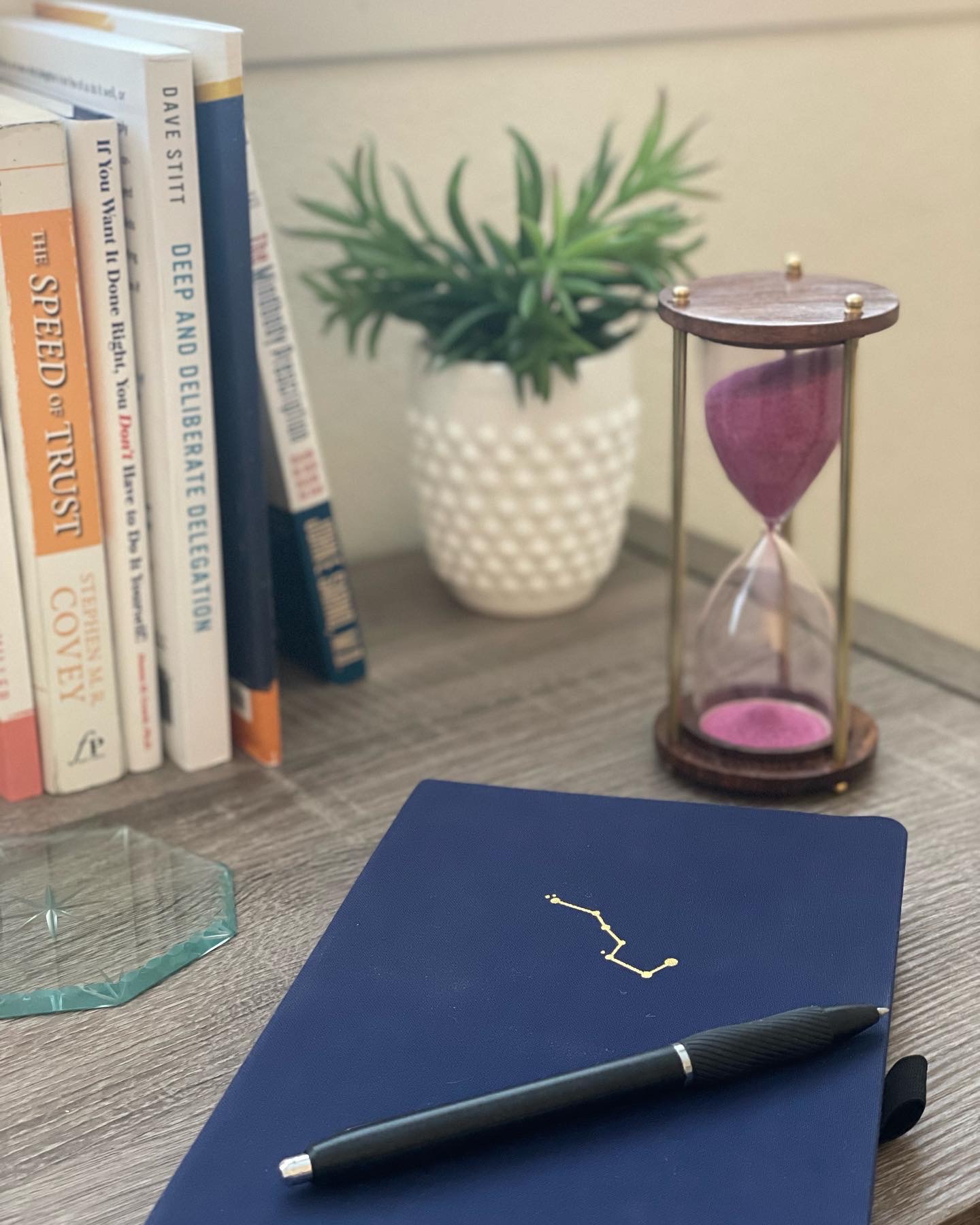
In March 2023, I wanted to start journaling – again. I have numerous journal books with a few pages filled and a mostly blank book following. But I decided to try again, first just running a 10-minute timer using a cool hourglass. I’d write for 10 minutes and call it good. That worked for a little while, but I eventually stopped journaling again.
Then in the fall of 2023, I listened to The Artist’s Way audiobook. There’s Julia Cameron telling me to write Morning Pages – three pages of handwritten, stream of consciousness journaling every day before I do anything else. I wanted to be the kind of person that journals but this felt like a huge commitment. Daunting, still. But her book is a 12-week program, so I made the commitment to do it for twelve weeks. I told myself that if after that timeframe I decided it wasn’t worth my time, I could release the commitment without guilt.
The result? I loved journaling and the habit finally stuck! Twelve weeks came and went, I decided to keep up the practice, and now I’m on Week 71!
100 Liminal Days
This one is the mother of all experiments I’ve tried so far. It was intense – I worked through many of the exercises in The Artist’s Way and wrote daily blog posts that totaled up to around 115,000 words before it was all done. This project allowed me the space to explore myself deeply, challenge myself through a self-initiation, and ultimately gain clarity around what to do with my time and talent.
100 days was an arbitrary target for my project, but as I review the trajectory of my journey from Day 1/100 to Day 100/100, I can see how this timeframe allowed for slow, intentional progress for my healing, identity release, and creative expression to receive the nourishment needed in order to finally understand what future I wanted to create for myself. I mentioned to a friend that I thought 90 days would have been enough – particularly because the holiday season at the end cramped my schedule and pulled my energy in new directions. But as I’ve thought about it more, I understand how even these days following 100 days are still working on me. (The journey continues, of course!)
Had I chosen a shorter timeframe – let’s say 50 days, I definitely would have missed some crucial lessons that came later in the project. For this type of lifestyle change, I needed a longer season and a more intense initiation.
I also made two big shifts throughout the 100 days, allowing myself to hold the plans lightly. On Day 34/100, I recognized my need to integrate what I was learning. I made a conscious decision to shift from soul excavation to creative expression, reducing the writing sprints and reallocating more time to qigong and art. On Day 69/100, I reviewed my habit tracker data and could see that where there was room for improvement. I moved the focus again and started focusing on more embodiment practices – my workouts and using qigong as a model for liminal navigation.
These intentional changes for the project were critical to my transformation.
What Makes These Experiments Successful
To sum it all up, there are five key elements to the experiment that make this work.
- It’s time-bound – a clear start and ending.
- I aim for gently exploration versus rigid rules – using what I learn from the experiment to iterate and customize my experience to fit my goals.
- I take small, faithful steps – trusting the process along the way.
- I document my progress and reflect – giving myself hard data to guide me through potential iterations and help me integrate what I learned across the entire experiment.
- I keep a willingness to continue the commitment as long as it serves me, and permission to stop if it does not.
Your Turn: What Will You Experiment With?
So here’s my invitation to you: What aspect of your life could benefit from a time-bound experiment?
Maybe there’s a habit you’ve been wanting to quit or start. Maybe there’s a creative practice you’ve been curious about but intimidated by the commitment. Maybe you’re in your own liminal space right now, feeling lost or unmoored, and you need a container to help you navigate it.
The beauty of experimentation is that you get to choose your own timeframe. It doesn’t have to be 100 days. It could be:
- A week of morning meditation
- 30 days without social media
- 12 weeks of a new creative practice
- 90 days exploring a career pivot
Pick something that feels both exciting and a little bit scary. Choose a timeframe that feels doable but long enough to actually learn something. Give yourself permission to hold it lightly – to iterate, to stop if it’s not serving you, and to continue if it is.
What I’ve learned through all of these experiments is that holding lightly to gentle exploration while taking small faithful steps forward leads us to creative expansion. The willingness to try is what opens the door to transformation.
The Journey Continues
My experiments with time-bound commitments have taught me more about myself than years of just thinking about change ever could. They’ve helped me quit alcohol, build a consistent journaling practice, and navigate one of the most transformative seasons of my life.
But more than the specific outcomes, experimentation has become a practice of self-discovery. It’s taught me that I can trust myself to keep commitments, that I’m capable of more than I think, and that the liminal space – that uncomfortable in-between – is where the real magic happens.
The journey continues, of course. There will be more experiments, more discoveries, more creative expansion. And I hope you’ll join me in seeing what unfolds when we give ourselves permission to try.
Sign up for my email newsletter for details about upcoming live qigong classes. You’ll also receive weekly summaries of posts, weekly qigong practice videos, and updates on other events online and in Austin.
Leave a Reply Cancel reply
Fresh Qi Newsletter

Stories, practices, and guidance for high performers who sense there is a better way
Amber Gray is an exited founder, certified Qigong teacher, and operational consultant based in Austin, TX.
© 2026 Embracing the tree, LLC. ALL RIGHTS RESERVED.
Amber gray
Huge thanks to the photographers who help me tell my story: @JaybrePhoto, @KimberlyMufferi, and @FeliciaReedPhotography
