

On Day 60/100, I shared how I integrate several daily practices as balance work to help reestablish temporal, somatic, relational, and meaning stabilizers when in a transition season. Today’s post is a brief overview of how I use a Notion habit tracker I created to support me in those daily practices through reflection and data capturing and analysis to help me notice patterns and trends.
100 Liminal Days is an experimental project of embracing my current transitional season after exiting my business by sharing an honest, real-time account of my self-initiation experience in daily posts. I’m using The Artist’s Way as a guiding tool, and sending shorter weekly recaps only via my newsletter. Visit Day 1/100 to learn more and sign up to get the weekly recaps delivered to your inbox.
Structure and Productivity Lost
Before selling my company, I had standing daily and weekly meetings, frequent requests for other meetings throughout the week, deliverables, and tasks that kept my schedule full. Like many people, the cadence of Monday through Friday was highly structured. The weekends might have had more flexibility at times, but I still had some consistent routines.
Then, in an instant after exiting, my days became wide open. No meetings, significantly less email, and almost nothing pressing to do. Sounds like a dream, right?
Only it turned out that extra free time wasn’t everything I thought it would be.
One of the biggest challenges within a liminal space is this strange loss of a sense of time. If you are in a transition similar to mine – shifting from a state of structure and productivity, into a more spacious, flexible state – having this extra time can have a disorienting effect. Left unchecked, we might fall into depression or experience other undesirable emotions like anxiety or irritability.
When we are coming out of this constant go-mode and higher levels of stress, taking some time to rest in the beginning is super important, but in short time, creating some daily habits and routines for ourself is equally crucial for stabilizing within the liminal space. We need some level of structure back, and it isn’t going to be there unless we create it for ourself.
How I Create Structure for Myself
Before leaving my company, I was already in a daily habit of journaling in my Daily Pages and practicing qigong. These are two things I expect I will do for the rest of my life, as long as I can physically do those things because of how much they benefit my overall wellbeing and happiness.
In addition to those practices, I have been able to gradually add in several new habits that have been especially helpful in this middle zone of life, and my Notion Mindful Rhythms Tracker has been an invaluable system to help me notice what areas of my life need that added structure.
The Mindful Rhythms Tracker
This has been something I’ve iterated on a lot over the years, but today’s version of it helps me track things like how much sleep I owe my body, my moods in the morning and the evening, how my body feels in the morning and the evening, how much water and protein I have consumed, and any days I choose to use substances to shift how I’m feeling. I also track my keystone habits: Daily Pages, Qigong, Meditation/Prayer, and Workouts.
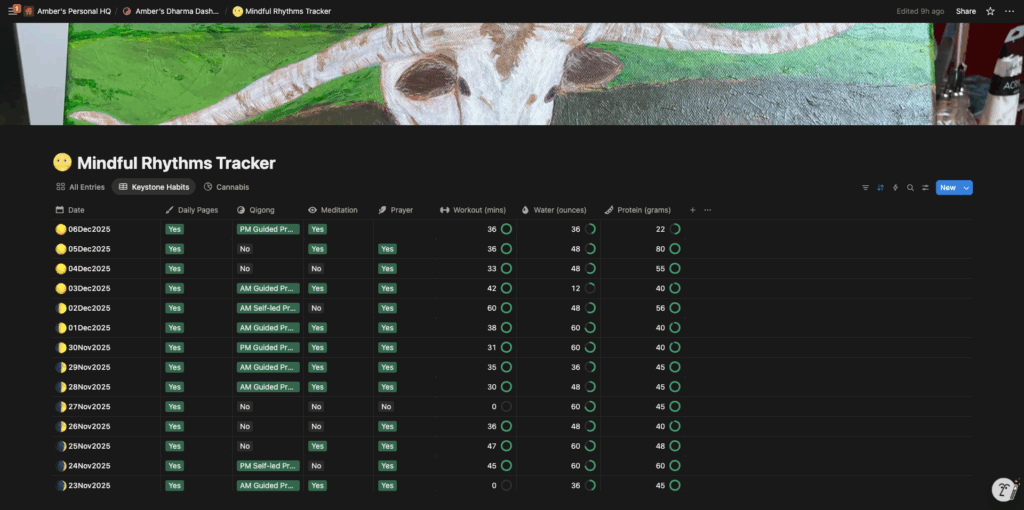
At a glance, I can see how consistent I am with these habits, but I can actually go beyond that by using the built in AI that comes with the Notion Business Plan ($20/month), and ask the AI to review my entries from a specific period of time and tell me what needs my attention.
I can ask things like, “What can I learn about solitude vs social time and next‑day mood?”
That simple question produced the following response from the Notion AI:
Here’s the simple read from your notes so far:
- Solitude plus creative practice tends to lift next‑day AM mood and steadiness. You’ve named the need to balance “connection with the divine (solitude) and connection with others (socializing)” and feel better when that mix is intentional.
- Too much solitude tilts toward loneliness; adding light social contact rebalances. You noticed the “ebb and flow between the poles” and that the time alone is powerful, but you must move between them on purpose.
- Social connection days can be energizing when paced. After social evenings that felt aligned (e.g., the book launch and new friends), your reflections read grounded and upbeat the next day.
- Depth work needs protection from social overflow. You’ve flagged that evaluating how much “deep work” you truly need helps you keep space for people without draining focus, which maps to better next‑day mood.
Net insight
- Intentionally pairing a dose of solitude for meaning-making with modest, high‑quality social time tends to improve next‑day mood.
- When urgency drops from 10 to 6, it’s usually after a day that included both a protected solo block and a low‑stakes social touchpoint.
One tweak to test this week
- Front‑load one protected solo block (pages or sprint) and schedule one light social micro‑dose (a walk, a short call). Track AM mood the next day for three cycles.
I know working with AI is not comfortable for everyone, but this has been huge for me. I actually canceled my ChatGPT account to use this instead because it has access to my Notion and can evaluate my workspace. I learn a lot by doing this.
Habit Tracking + Gratitude, Wins, and Great Things
I track my habits for two reasons:
- Tracking reminds me to do the things I committed to doing. For example, today, I have not had prayer time yet and I can see that by looking at the tracker. At bedtime, if I still haven’t done this, this signals to me to have a quick prayer session before sleep.
- Tracking gives me an incredible database of how I am feeling, acting, and thinking. Awareness like this makes it easier to notice if a certain mood or physical feeling is tied to a certain behavior, allowing me to consciously make changes as needed.
But tracking my habits isn’t the only thing I keep up with in this tracker. I also write three things I am grateful for each morning. At the end of the day, I fill out a section called “Wins and Great Things Today” and I either quickly bullet list awesome things from the day or I may write longer journal entries talking about my day. This focus on wins and great things helps me end the day with gratitude and always finding something good, instead of just journaling about whatever might be on my mind.
Then, I take it a step further and answer the question, “how does this connect with my dharma?” Sometimes it may just be acknowledging that nurturing an important relationship brings joy to my life, or it may be about something bigger and long term. No matter what, I always find something from the day that ties to my dharma or purpose.
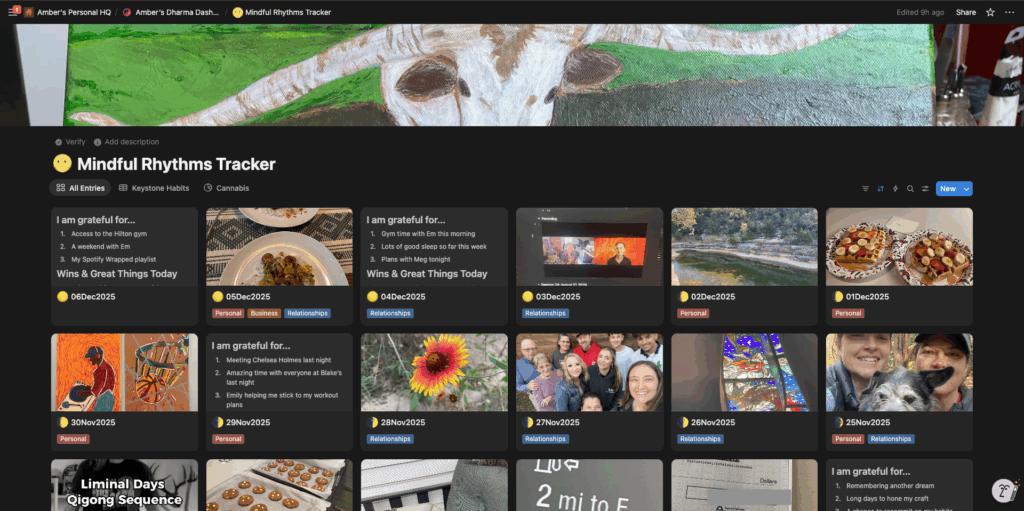
I’ve designed one view of the tracker to either show those three things I’m grateful for, or a photo I took that day. It’s fun to scroll through and see my life in pictures or gratitude. It reminds me of how beautiful my life really is, even on the hard days.
Using this tracker has been such an anchor for me during this awkward transition season I’m in. It helps me create some structure to my days even though I don’t have “work” to do that others hold me accountable to do. For me, tracking my habits has been one way to help myself feel grounded and more aware of what I’m feeling, doing, choosing, needing, etc. It’s a way I am able to look inward more efficiently.
Something For You
If you feel like you are just floating in space because you aren’t sure what’s on the other side of your canyon, establish some daily routines. Wake up at the same time. Time block some dharma sprints to work on a creative project or your job search if that’s what you need. Go to bed at a consistent time, too, and take care of your body. (Btw, I have created a free blank Notion template of this tracker, and anyone who signs up for my email list will receive it instantly. Scroll down below the comments for a video walkthrough to learn more.)
Focus on these things first, and soon, you will know what to do next.
Weekly recaps of 100 Liminal Days are emailed on Tuesdays only to my newsletter subscribers. If you want the summaries, share your email here to get on the list. You’ll also instantly receive a free Notion template I use every single day to track my habits and reflect on the day.
Leave a Reply
Get Weekly ReCaps of My Spring Equinox Experiment

Last year, I completed a project called 100 Liminal Days that changed my life and showed me the power of time-bound experimentation.
Now, from January 26, 2026 - March 16, 2026 (50 days), I'm working to build a sustainable restorative habit of cooking meals mindfully instead of eating so much takeout and pre-made meals in single-use containers. You can learn more about the project here. Check out the book that inspired the project, Meaningful Minimalism for inspo for your own exploration!
In my weekly newsletter, I will share updates on the experiment (like these!), short beginner-level qigong practice videos (like these!), and stories behind my art (like these!)
Sign up below to receive weekly updates and I'll send you this free Notion habit tracker template I created to elevate self awareness and journal about the day.
