
December 15, 2025
In liminal seasons, we can clear a path for clarity to join us on our journey by developing and trusting our consistent daily rhythms. Small, repeatable practices regulate time and our sense of self when everything else in our lives may feel unsteady. In today’s post, I’m sharing a basic routine that gently helps you reorient your soul’s proprioception. Soul proprioception is the name I’m giving to describe our ability to sense who we are, what we want, and where we are going, because these are the coordinates that seem to get scrambled when we enter that in-between phase of life.
100 Liminal Days is an experimental project of embracing my current transitional season after exiting my business by sharing an honest, real-time account of my self-initiation experience in daily posts. Visit Day 1/100 to learn more and sign up to get the weekly recaps delivered to your inbox.
When I first began 100 Liminal Days, the most important part of this project was an unwavering commitment to several keystone habits that have been crucial for stabilizing my soul during this transitional time. Practices like daily journaling, meditation, prayer, qigong, and exercise have helped me steady my soul and prepare myself to do heavy work that helps me redefine who I am now that I’ve experienced this ending of my past career and vocation. Without the balance work of daily practice, diving into heavy soul work might actually make matters worse, but with my keystone habits strong, I have learned to pace depth over time.
Slow Stabilization for Life’s Transitions
In William Bridges incredible book titled, Transitions, he states that every transition has three parts that come in this order:
- First, we experience an ending
- Then, we enter into what he calls the neutral zone (and I call the liminal space)
- And finally, we reach our new beginning
We usually are well aware of the boundary edges of our ending, but as we enter into that neutral zone in the middle, the edges begin to blur and time feels like it collapses. We may have an idea of our new beginning approaching in the near future, or we may have no clue what’s next. The latter was my experience, and because I couldn’t tell when this neutral zone would taper down into my new beginning, my inner compass and clock was notably scrambled.
I didn’t understand that at first and all I really wanted was to get out of this neutral zone as soon as possible. I grasped for anything to try to figure out what my “next” would be, and I did that by using some heavy soul work tactics to dive deep into my subconscious to figure out what I really wanted.
Because I began those long, deep dives in such a hurry, I actually made my issues worse! I can see now that the right approach is to choose slow stabilization first, then take intentional steps into depth. What I’ve learned is that the true gift of the liminal space comes out of this slow stabilization paired with calculated deep dives and plenty of integration time in between.
Keystone Habits as Temporal Scaffolding
In Part II of my mini-series on “soul proprioception” I compare the physical body’s temporal mechanisms with that of our soul’s temporal mechanisms. The body’s ability to know where in space our limbs are, how much force is needed to lift an object, or how far to reach for something is a finely tuned sense that is constantly running a forecast of our body’s position a few milliseconds ahead. If our body’s proprioception gets skewed, we might run into things or miscalculate the amount of force needed to pick up a light object, for example.
Modeling this body function over the soul in a liminal space, we might describe the experience as a breakdown of the forecasting system. In a more normal part of life outside of the transition time, this system would help us understand the correlation between our actions today and our outcomes in the future. But in the liminal space, it becomes difficult to connect how our decisions today will impact our future, and often times it leaves us feeling helpless and frozen in this void-like space.
The good news is that we can heal this broken forecasting system within us by creating some temporal scaffolding – daily practices that restore our sense of time and get that forecasting system back online. Daily habits like journaling or working out can help us anchor ourselves into a new identity that stands true even when we don’t have work or a relationship to help define us.
Developing some daily habits can help you:
- Regulate your sense of time and your attention
- Reduce decision fatigue
- Build trust with yourself (crucial to discovering your next!)
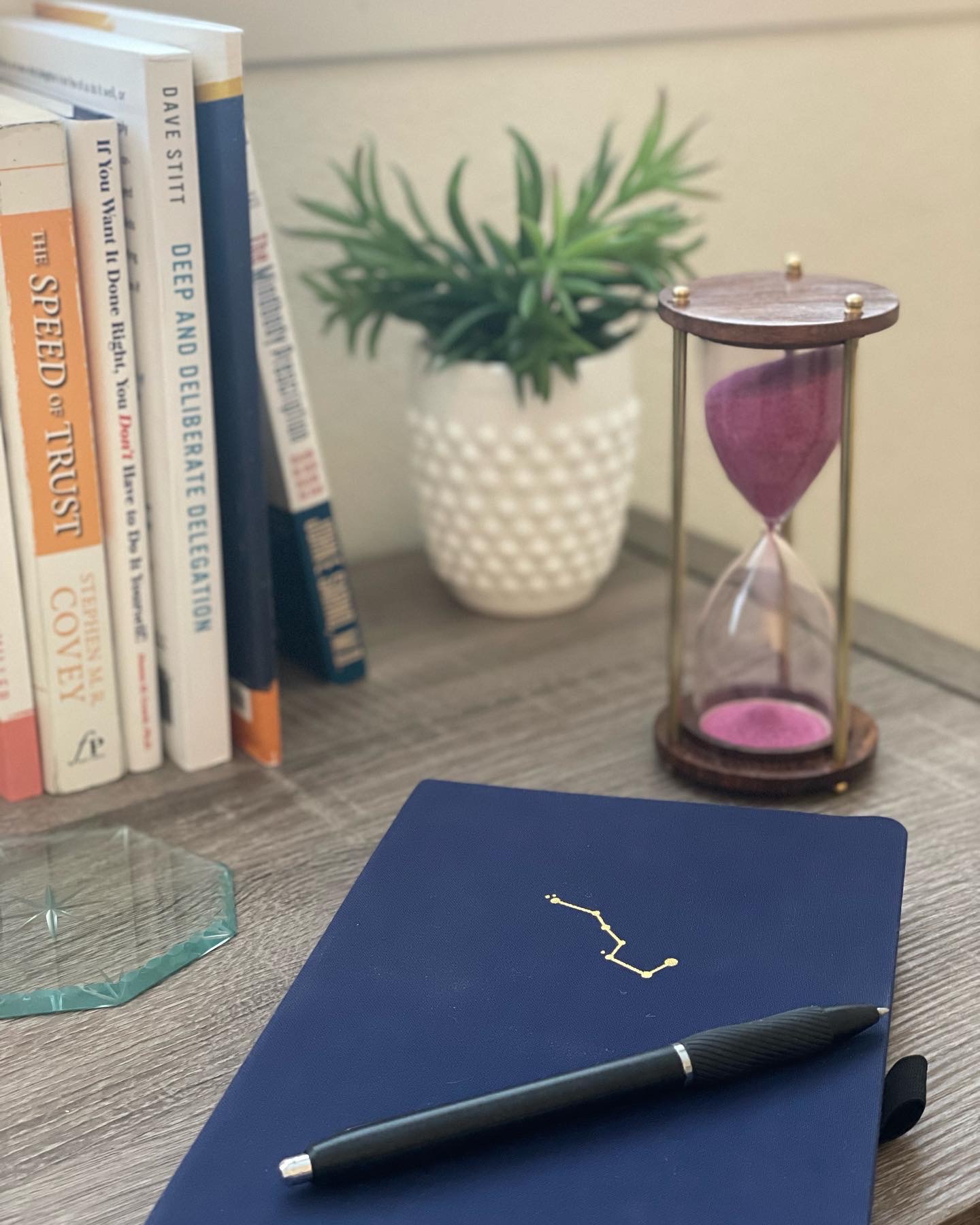
My personal dailies have expanded to something that might feel intimidating to someone who doesn’t already have a serious morning routine, but when I first started out developing my habits, I took small steps. I set timers for myself instead of setting goals for specific amounts of output. For example, I’d journal for 10 minutes using an old fashioned sand hourglass. Once I was doing that consistently, then I changed my goal to write two full pages in my notebook for twelve consecutive weeks. I told myself if I got to the end of twelve weeks and wasn’t benefiting from the habit, I had permission from myself to stop doing it – guilt-free. (I found tons of value, so I kept going – now I’ve been writing two pages per day for sixty-six weeks!)
Choose 1-2 Tiny Moves
Let’s start small. Choose one or both of these practices to commit to for 30 days. If after one month of practicing, evaluate your experience. Did it help you? Did you learn anything? Do you want to keep doing it? If the answers to any of those questions are “no,” give yourself permission to stop without an ounce of guilt or negative self-talk. And if the answers are yes, now you know that practice is something worth keeping up.
Practice 1: Morning Pages (Hourglass Edition – 10 Minutes Daily)
The most important practice I do every day is to journal in the morning. Julia Cameron, author of The Artist’s Way calls these “Morning Pages”. I call them Morning Pages or Daily Pages (because sometimes I do them later than morning!) This is a type of journaling that might be considered a “brain dump” because it is just stream-of-consciousness writing – unedited, free-flowing, and literally just whatever comes to your mind. The goal is to declutter your attention with a purge. (It’s like a micro release of the old every morning!)
Set a timer on your phone, or get a 10-minute sand timer if you want to keep it analog. Write long-hand in a notebook, and when the timer is finished, stop wherever you are.
If you feel big resistance to handwriting and really want to type, I won’t tell you that’s the wrong way to do it. Just keep in mind that handwriting slows your pace down intentionally, giving your brain time to process what you are feeling and thinking at a more reasonable pace.
The only rule I will ask you to follow is to tell the truth. Truth-telling to yourself does something huge for our lives. No one is going to read this but you (and even you don’t have to read it!) This practice will help you elevate your awareness of your self and your desires – two big insights for moving out of the liminal space.
Practice 2: Get Outside and Touch Grass (5 Minutes Daily)
I know this might sound like hippie stuff again, but this practice offers quick nervous system regulation through sensory grounding. Go outside, kick off your shoes, and feel the grass beneath your feet. If you aren’t up for going barefoot, that’s okay. Find a spot to sit comfortably outdoors.
As you take in the feelings of nature, take long, slow, deep breaths in and out. Notice what you hear, see, smell, and feel. A breathwork instructor once told me that our nervous system doesn’t understand words, so telling ourselves to chill or calm down doesn’t work. We must show our nervous system that we are safe, and we do that by breathing slowly, in through the nose, out through the mouth. Do this for 3-5 minutes per day for 30 days and notice how you feel.
How to Keep It Slow
These practices are meant to be subtle and slow. Ten minutes of journaling will make a difference; five minutes in nature will, too. It’s okay to stop once you hit the timer’s end. The key is to commit to doing it every day. Choosing the same time each day is ideal for making it a real habit, but it’s okay if you miss it in the morning and want to do it before bed when you remember. We’re not going for perfection, we’re going for consistency.
If you miss a day, restart again the next day. Tell yourself it’s okay that you missed a day and you’ll start again. Now, missing two days in a row gets to be slippery real fast, so make a commitment not to miss more than one consecutive day.
Remember, progress in the liminal space is rhythmic, not heroic. For the next 30 days, choose one tiny move and let it be enough. You’re rebuilding the scaffolding that keeps your inner compass online. Slow is the strategy.
Weekly recaps of 100 Liminal Days are emailed on Tuesdays only to my newsletter subscribers. If you want the summaries, share your email here to get on the list. You’ll also instantly receive a free Notion template I use every single day to track my habits and reflect on the day.
Leave a Reply Cancel reply
Get Weekly ReCaps of My Spring Equinox Experiment

Last year, I completed a project called 100 Liminal Days that changed my life and showed me the power of time-bound experimentation.
Now, from January 26, 2026 - March 16, 2026 (50 days), I'm working to build a sustainable restorative habit of cooking meals mindfully instead of eating so much takeout and pre-made meals in single-use containers. You can learn more about the project here. Check out the book that inspired the project, Meaningful Minimalism for inspo for your own exploration!
In my weekly newsletter, I will share updates on the experiment (like these!), short beginner-level qigong practice videos (like these!), and stories behind my art (like these!)
Sign up below to receive weekly updates and I'll send you this free Notion habit tracker template I created to elevate self awareness and journal about the day.
