
February 22, 2026
Last fall, I surprised myself by writing in my journal, “Qigong is my axis mundi.”
I didn’t fully know what I meant yet, but it landed with the weight of truth. In the weeks that followed, dreams, synchronicities, and quiet curiosity kept pulling me back to the question: Why did I write this? What does it mean for the way I live?
My Axis Mundi: The “Immoveable Spot”
The word axis mundi essentially translates to “the immoveable spot” and describes something acting as a conduit between heaven and earth. That meaning connects deeply for me, but in more plain terms, qigong is more than just another practice I added to my morning routine – it has evolved to become a central part of how I access control over the pace of my life, and how I live in compassionate service to others.
A few months ago, I stumbled upon a Substack called Liminal Lab by Dr. Chris Hoff, an entrepreneur and therapist guiding people and organizations through transitions, or liminal space. The content is generally geared toward therapists, but I’ve still found a ton of inspiration and lines of questioning that have resonated with my own liminal journey.
The Line That Stopped Me in My Tracks
About a week ago, he shared a short post about a 2013 Harvard art historian named Jennifer Roberts who gave her students a challenging assignment – to look at one single painting for three hours. Not to research it or study it, just to look. And then Dr. Hoff reflected on Roberts’ teaching with words that I had to linger with:
She called patience “a form of control over the tempo of contemporary life.”
But here’s what haunts me: In 2013, slowness was still available to be chosen. In 2026, slowness requires structural intervention.
That last part has an underlying, scary truth to it: in 2026 slowness is not something we can just freely choose anymore. We must restructure our lives and our mindsets before we can access slowness.
Many people don’t see why slowness even matters. Others intuitively know they need it and desire it but they are caught up in systems, cycles, and habits that block them from stepping into a slower lane. (Life be life-ing, right?)
No Pain, No Gain Causes Diminishing Returns
For years, I was one of the many who did not see that slowing down could actually be good for me. I took pride in my hard work ethic and I identified as a “go-getter” – someone who would never give up in pursuit of achieving more. Phrases like, “no pain, no gain” taught me to push past my pain and discomfort and keep faith that something better is always on the other side of it all. I believed it would be worth it one day. My resilience and persistence were key to my eventual career success despite having no college education or financial security growing up, and little exposure to healthy mentorship and guidance along the way. But even in that success, it was never enough and I was secretly dissatisfied, hoping my breakthrough was right around the corner.
The “no pain, no gain” motto also applied to my physical body. Wanting to be a well-rounded and “healthy” individual, I believed I needed to exercise hard and more frequently in order to take better care of my body. I believed I wasn’t doing a good job of that because my body was nearly always in some degree of pain.
I assumed that since my physical body hurt, it must be because I’m not fit or healthy enough, or that I sit too much. I sometimes thought maybe there was something structurally wrong with my body. I could see others running and lifting weights every week, looking healthy, and eating better than I did. So, I figured, I must just not be committed enough. I enrolled myself in bootcamps, gym classes, half marathons, one full marathon (not doing that again!!), workout programs, and chiropractic care.
And then came the diminishing returns. I didn’t know that the literal constant tension I carried for many years was not the normal state of the body, and the more I “toughed it out,” the worse it became. My old ways of surviving had become the force behind my downward spiral. And the only reason I realized I had to make a change was because my body had finally had enough, and I could no longer ignore its cries for help.
Change Begins with Curiosity
Change for me began with a small amount of curiosity.
What if my body was hurting because of emotional trauma? Did I have unprocessed emotions to deal with?
I read the Mindbody Prescription by Dr. John E. Sarno and decided there must be some truth to this. The more I learned, the more I realized that my body was probably not punishing me, it was just speaking the only way it knows how. My body was teaching me the power of slowness and asking me to look inward.
Structural Intervention Takes Time
But as we discussed earlier, slowness is not easily accessed in this modern age. I wasn’t able to just decide to slow down and suddenly feel better. Slowing down required a structural intervention.
And to be blunt, this restructuring took me no less than three years. Slowing down is not something we just decide to do. It is a process that could take years.
Mentors Can Change the Timeline
Some of that extra time was because I had to learn from my own experiences. I didn’t have a teacher or mentor to show me the way – that is, until two years into it all when I worked with my coach, Andrew. For six months in 2024, Andrew guided me through Internal Family Systems therapy sessions weekly on Zoom to work through varying degrees of emotional unrest. He also facilitated two intentional plant medicine ceremonies for me, gave me journaling assignments, and introduced me to qigong – all of which accelerated this restructuring I needed in order to choose a healing pace of life for myself. Without his guidance, I know I would not be where I am today.
Qigong Makes Slowness Accessible
Qigong was initially just one of the smaller takeaways Andrew offered me, but as I anchored myself in this practice daily – day after day, week after week, month after month, and beyond – I felt my body releasing tension. With my body relaxing, my awareness began to expand. Clarity came and I knew what further restructuring was necessary for me to become healthy – physically, emotionally, and spiritually.
Qigong has helped me restructure my lifestyle so I can access slowness anytime I need it.
If that Harvard art historian is right about patience being a form of control over the tempo of our contemporary life, practicing qigong could be the most accessible way to begin taking back control over the pace of our lives. With just 10-15 minutes per day, I created space for my body to heal itself incrementally. I created space for my mind to quietly observe the truth of what I need and want. From there, anything else I desire feels possible.
Qigong has taught me to partner with the wisdom of my body instead of fight it.
With the physical tension released, I’ve been able to reintroduce strength training, long hikes or bike rides, and even hours of yard work without any amount of pain returning. Apparently, the normal state of the body is not constricting into a dense ball of pain every day!
With the emotional tension released, I’ve been able to live truer to myself. Understanding what I need and want has challenged me to make changes that have not been easy at all, but with every step forward in authenticity, another layer of peace blankets over me.
An Invitation
Change begins with just a small amount of curiosity. If you are curious about qigong and why I’ve called it my “immoveable spot”, try practicing for 10-15 minutes each day for a week and notice how you feel. I’m building a library of guided practice videos for beginners on my qigong YouTube channel because this practice has changed my life, and I hope it will make your life better, too.
And if you aren’t ready yet, that’s okay. I’ll be here, breathing slowly, moving mindfully, and sharing my experience along the way. Join me when the time is right for you.
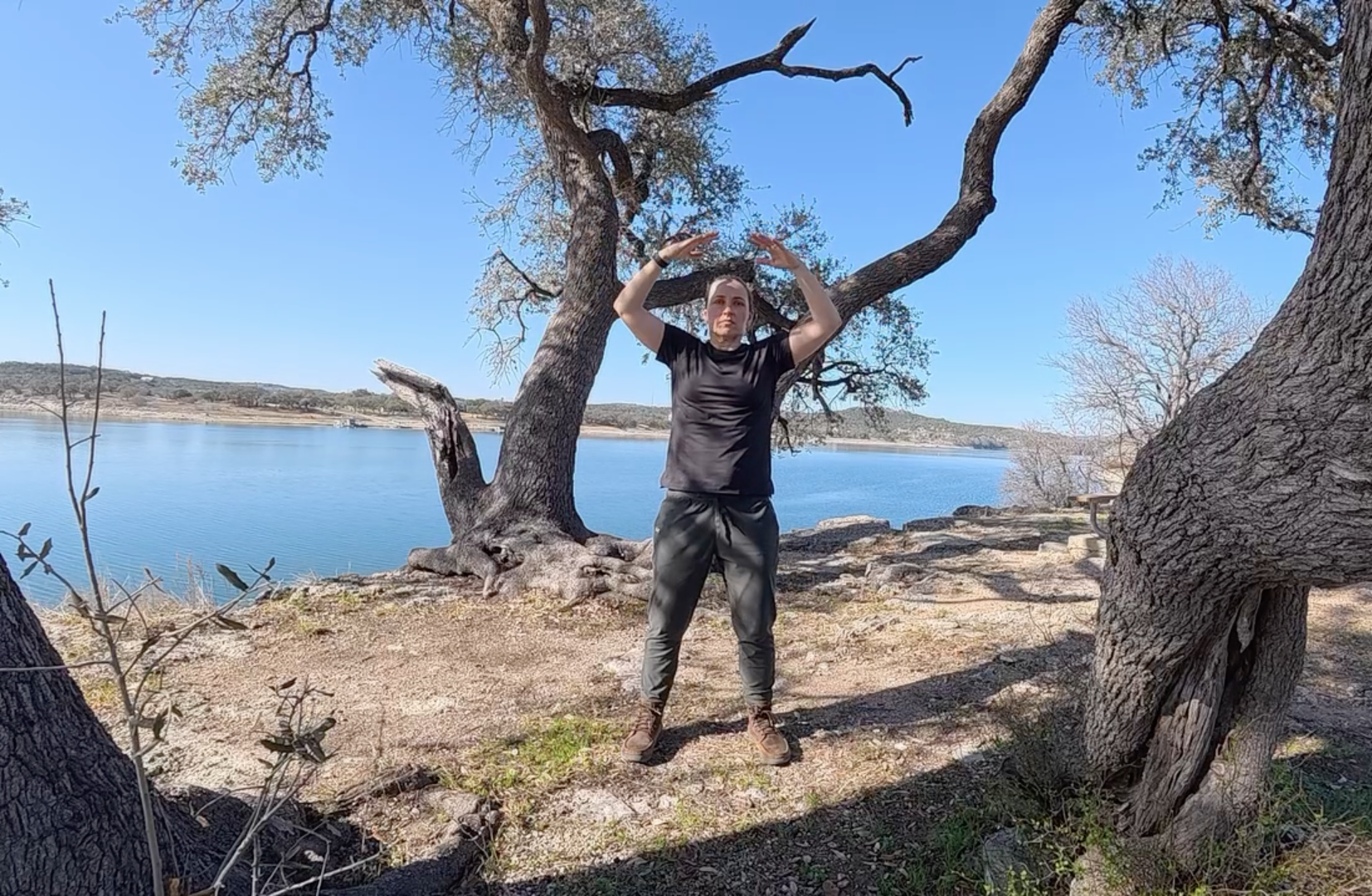
Enjoying qigong and interested in a live experience? Sign up for my email newsletter for details about upcoming live classes. You’ll also receive weekly summaries of posts, weekly qigong practice videos like this one, and updates on other events online and in Austin.
Leave a Reply Cancel reply
Get Weekly ReCaps of My Spring Equinox Experiment

Last year, I completed a project called 100 Liminal Days that changed my life and showed me the power of time-bound experimentation.
Now, from January 26, 2026 - March 16, 2026 (50 days), I'm working to build a sustainable restorative habit of cooking meals mindfully instead of eating so much takeout and pre-made meals in single-use containers. You can learn more about the project here. Check out the book that inspired the project, Meaningful Minimalism for inspo for your own exploration!
In my weekly newsletter, I will share updates on the experiment (like these!), short beginner-level qigong practice videos (like these!), and stories behind my art (like these!)
Sign up below to receive weekly updates and I'll send you this free Notion habit tracker template I created to elevate self awareness and journal about the day.
