
December 5, 2025
Currently, I am noticing a lot of overlap regarding the liminal space, qigong’s standing pose called “Wuji”, and a concept sometimes referred to as the Third Way. In today’s post, I’ll attempt to explain this overlap and how these concepts are providing me with a deeper understanding of how to view transition seasons as life’s creative studio instead of what looks like a messy middle at first glance.
100 Liminal Days is an experimental project of embracing my current transitional season after exiting my business by sharing an honest, real-time account of my self-initiation experience in daily posts. I’m using The Artist’s Way as a guiding tool, and sending shorter weekly recaps only via my newsletter. Visit Day 1/100 to learn more and sign up to get the weekly recaps delivered to your inbox.
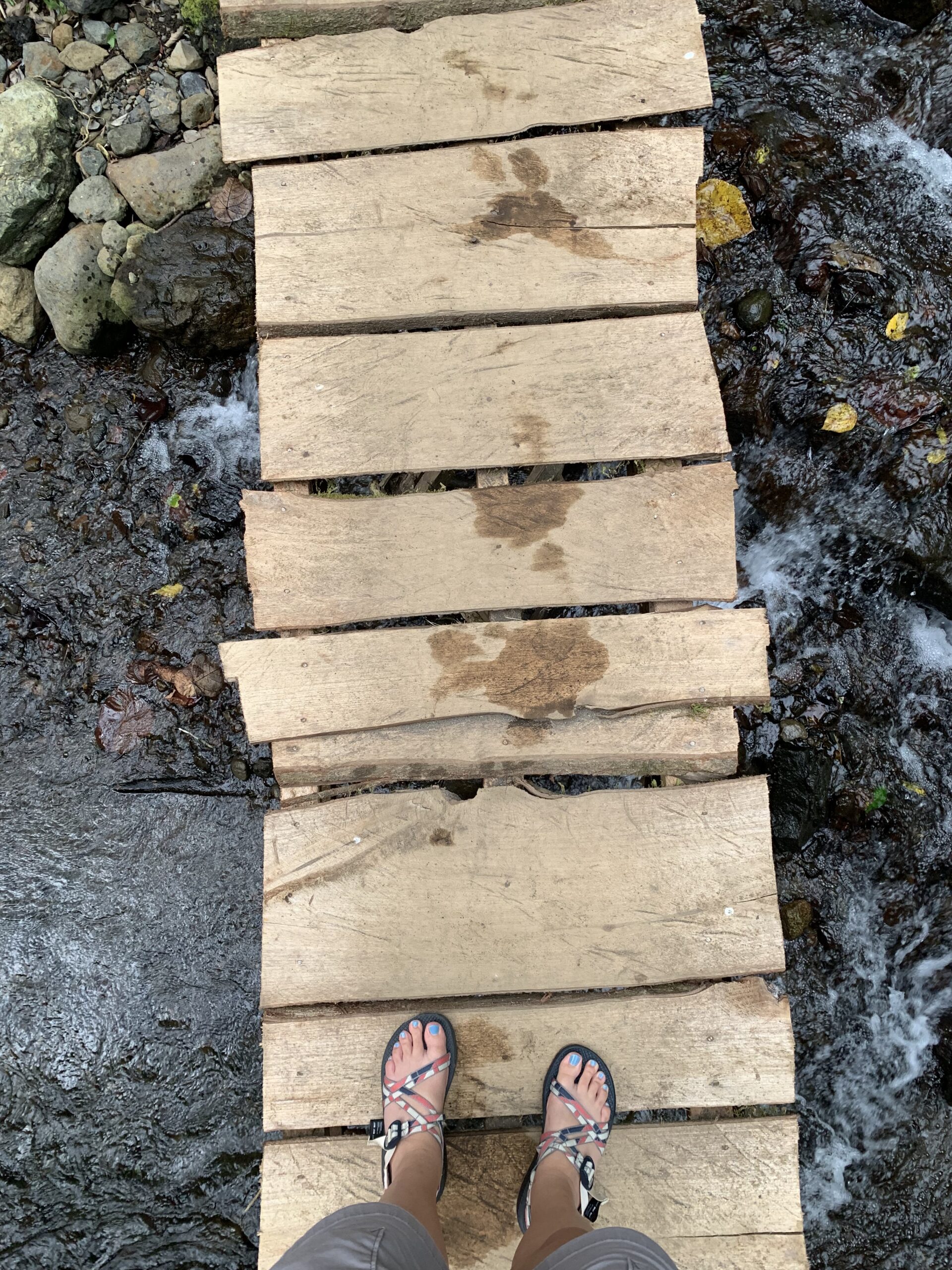
Rope Bridge Across the Canyon
One notable characteristic of life outside of a liminal space is that it typically feels rigid and stable, where the liminal feels shaky and uncertain.
Think of a deep and wide canyon with a rope bridge across. The canyon is so large that you can’t really see the other side clearly, but you know it’s there in the distance. Perhaps you can even see and hear other people over there. Maybe some are playing and laughing, others are building something, and maybe one of them is looking at you and waving to you to come on over.
As you stand on your side of the canyon, you feel safe, but things are changing. The environment is dulling. What once was safe and made you feel alive and full of joy seems to be fading. You feel a desire growing within you.
You want to go to the other side of this canyon.
But the only way across is to step onto that flimsy, swaying rope bridge, and to keep going until you reach the other side.
The other side of the canyon seems to be calling to you, even pulling your soul closer to the edge, but whoa, that bridge looks terrifying. Still, you wonder what life is like on the other side. You dream about it. The desire intensifies, even though it seems like the trip will be treacherous. Eventually, you gather the courage and make a decision to leave this dull side and set out on your journey across the bridge.
Once you get out there in that middle space, you wonder if you have made a mistake. The wind is blowing your bridge, you feel it swaying under your feet, and you aren’t even sure how much longer it will take to reach the other side. You look back at where you came from – that steady safe place – but now it’s really fading fast. What was there before now looks fuzzy and lifeless, and regret begins to set in. This is the moment you’re tempted to choose speed over steadiness.
You are in the liminal space.
Going back is no longer an option. The only way out is through, and you learn quickly that you cannot rush the process. Moving forward too fast just makes the bridge swing more. Suddenly, fears flood your mind and you are frozen. It feels like your sense of time collapses, too. The skills that helped you thrive on the edge of the canyon are of no use to you here.
How do you overcome? How do you get out of this liminal space?
On a swaying bridge, technique matters more than willpower. That’s why I’ve started to see liminal spaces as dojos to practice within.
Liminal Spaces as Dojos
Crossing this canyon requires something different of us, and it can be counterintuitive, but this is why I call the liminal space a gift and a dojo. Because what we are poised to learn here in this in-between is like nothing we’ve ever experienced or done before.
“Dojo” is a Japanese word literally meaning “the place of the Way,” and is used to describe a hall or place for immersive learning, experiential learning, or meditation. It’s usually used when referring to the place where one practices martial arts, but I see the liminal space as a kind of dojo, too. I’ve begun calling liminal spaces – transitional times of our lives – gifts because my experience intentionally lingering in a transition instead of trying to get on to the next thing quickly has become transformational for my life.
As I’ve experimented here in my own transition for the last 75 days, there are two concepts guiding me to begin my journey of emerging from the liminal space. The view of the other side of my canyon is clearer, but I had to practice lingering in the middle before I could carry on my journey across. Bear with me – I realize these are challenging concepts at first blush, but I’ll explain further to make sense of it all.
These two concepts are:
- Wuji – a Chinese word literally meaning “ultimate nothingness”; It is the word to describe a specific qigong standing meditation pose, or Zhan zhuang.
- The Third Way – A solution/belief/way that emerges when we hold tension between two opposing forces
Qigong Pose Called Wuji
On Day 33/100 of my experiment, I learned this concept of Wuji in my qigong teacher training and wrote more on Day 42/100 about how Wuji as a qigong pose is essentially embodying that middle space I am experiencing emotionally as I transition to a new vocation. The pose is meant to help us build up more Qi, or life energy, within our body. Wuji as ultimate nothingness is the space where Yin and Yang emerge – that is to say where the balance of the universe comes from, between two opposing forces of the universe.
In our liminal space on that rope bridge, balance is the first thing we are grasping for. Standing in the Wuji pose is a way we can physically embody this concept of The Third Way – holding the tension between two opposing forces (like Yin and Yang).
But to try to get us back to practical terms 🙂 – by using this pose, we are training our nervous system to hold this tension. On the rope bridge, Wuji feels like soft knees, easy breath, eyes wide enough to take in the horizon. It’s the stance that stops the wild swing.
The Third Way
The Third Way is the unexpected synthesis that appears when opposites are held without rushing. A few days ago, I shared a quote from Jungian analyst, Marion Woodman speaking to Jung’s belief that when we “hold conflict in psychic utero” for the right amount of time without rushing it, we give birth to something new – a third way.
This term “Third Way” is also used in modern ways to describe certain Christian beliefs or politics that do not land in the worlds of extremes. Some misinterpret this to think the Third Way is a mushy middle ground that doesn’t choose a side, but truthfully, the Third Way has a spine. Choosing the Third Way requires more courage and it means we acknowledge that we might be wrong about some things. It prioritizes posture over position.
On the bridge, that looks like steadying on the boards first, then choosing from a wider set of options – not sprinting to the cliff.
Tying It Together
One of the benefits of having a strategic mind is being able to notice patterns and connections between systems. My brain likes to play with metaphors from working systems in one area and see if they can help bring color to other complex ideas. I’ve been seeing these concepts of Wuji and the Third Way (and the rope bridge across the canyon) as beautiful metaphors to help me navigate this transitional season. (And hopefully the way I have described it is not too far-fetched for others unfamiliar with the terms to understand!)
In a liminal space, we can restore our sense of time and our identity when we understand the power of holding this tension between the two sides of our canyon – that is, who we were before and who we are becoming. We don’t discover the black and white answer to “what’s next” in this space, but if we can hold this tension in psychic utero, we surely will birth something new and understand how to carefully take the next step across that rope bridge.
When I map these systems onto each other – bridge, body, psyche – they keep telling the same story: steadiness precedes clarity.
For Those In Transition
If you are standing on your own rope bridge now, you may be feeling frozen or at least a bit wobbly. Your first thought is likely to run forward toward that other canyon cliff – or really anything that resembles it. But pause here. Take a deep breath, and plant your feet. Connect with your rope bridge. Steady yourself with your breath and maybe even consider practicing qigong. (Visit my YouTube channel for simple practice videos.) Practice holding that tension you feel in your liminal space. Don’t rush out. When urgency drops from 10 to 6, options multiply. I promise you will discover what to do next.
Weekly recaps of 100 Liminal Days are emailed on Tuesdays only to my newsletter subscribers. If you want the summaries, share your email here to get on the list. You’ll also instantly receive a free Notion template I use every single day to track my habits and reflect on the day.
Leave a Reply Cancel reply
The Fresh Qi Newsletter


Amber Gray is an exited founder, certified Qigong teacher, and operational consultant based in Austin, TX.
© 2026 Embracing the tree, LLC. ALL RIGHTS RESERVED.
Amber gray
Huge thanks to the photographers who help me tell my story: @JaybrePhoto, @KimberlyMufferi, and @FeliciaReedPhotography
